
Consumer insights is having a strange moment. There is more data available to researchers than at any point in the industry’s history, yet many teams still feel like they are chasing signal instead of finding it. AI has made it easier than ever to collect survey responses, summarize transcripts, or run a virtual focus group. It hasn’t automatically made that data more accurate. More volume is not the same thing as more truth, and that distinction is at the center of one of the industry’s most persistent blind spots, the gap between what shoppers say and what they actually do.
A Short History, From the Kitchen to the Cloud
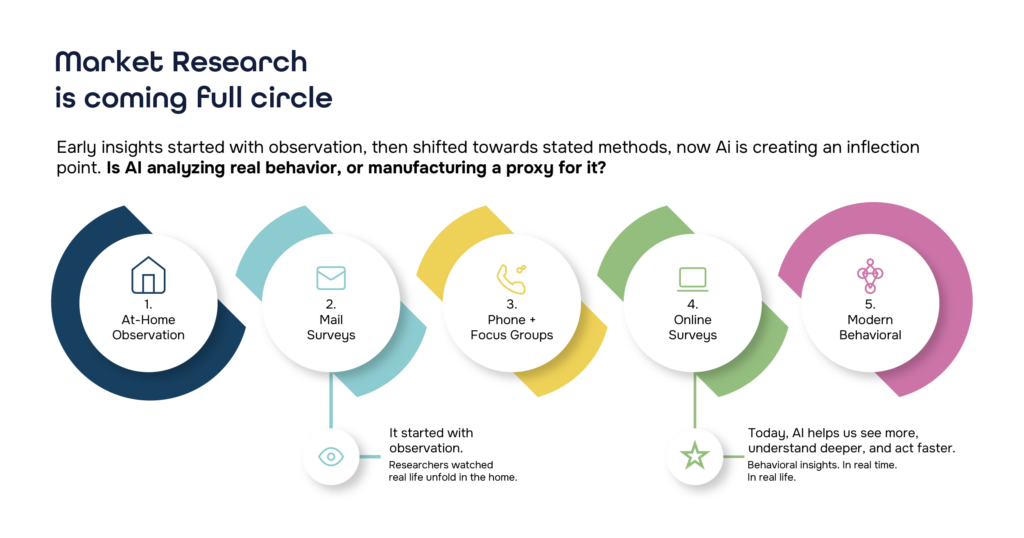
Consumer insights did not start as a survey business. It started as an observational one. In the 1950s, researchers, mostly women in one of the earliest professional roles open to them, sat in real kitchens and watched real households go about their routines. They took notes by hand and filled diaries, which they shipped back to headquarters for analysis. It was slow, small-scale, and rooted entirely in behavior, not opinion.
The industry changed with the rise of the online survey. Suddenly, any brand, from a global CPG company to a neighborhood business, could ask people questions directly and get answers within days instead of months. It was a genuine breakthrough for accessibility and speed, and it is fair to credit the survey boom with much of the industry’s growth over the last three decades.
But speed came with a cost. Somewhere along the way, “what people say” quietly became a stand-in for “what people do.” Those are not the same thing, and the industry mostly stopped questioning whether they were.
AI’s Real Opportunity Is Not a Better Chatbot
The temptation with AI right now is to point it at the same problem the industry has always had, and simply make the old tool faster. Swap the online questionnaire for an AI chat interface, and call it innovation. That has a place, but it does not solve the underlying issue.
As Amit Dhand, Co-founder and Chairman of Nailbiter, says,
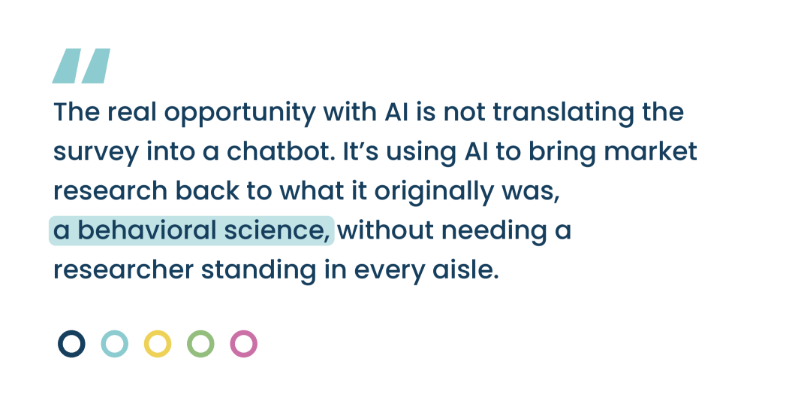
That reframes the whole conversation. AI’s most valuable role is not asking people more questions; it is making it possible to observe and analyze behavior at a scale that was never practical before.
What the Say/Do Gap Is, and Why It Is Widening
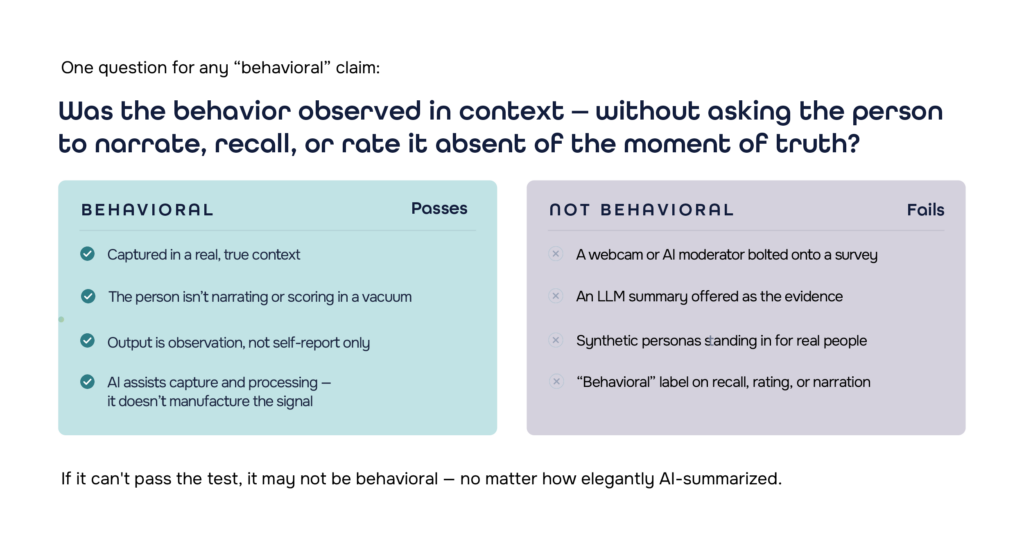
The say/do gap is exactly what it sounds like. It represents the distance between what someone reports about their preferences and priorities, and what they actually do when they are standing in front of a shelf or scrolling a product page. People aren’t being dishonest. Stated intent and in-the-moment behavior are shaped by entirely different forces.
As brand and insights teams have leaned more heavily on surveys over the past three decades, that gap has not narrowed. If anything, it has widened, because the tools most commonly used to measure shopper decision-making were never designed to capture behavior in context. They were designed to capture opinion.
This matters because insights teams are not really in the business of collecting opinions. They are in the business of enabling decisions, and some of those decisions carry real financial weight. Getting the say/do gap wrong does not just produce an inaccurate report; it can quietly steer an entire innovation pipeline in the wrong direction.
Closing the Gap Requires Watching, Not Just Asking
This is where behavioral data changes the equation. Instead of asking shoppers to reconstruct or predict their own decision making after the fact, behavioral research observes what actually happens as the decision is being made, in real stores and real digital environments, without relying on memory or self-report.
At scale, this becomes a genuinely different kind of dataset. Nailbiter’s approach has built what is now the world’s largest behavioral data platform, drawing on more than a million recorded shopping trips across in-store and online environments. That volume matters because it turns individual observations into patterns that hold up across categories, retailers, and shopper segments.
It also underscores just how little room brands actually have to work with. Shoppers are not deliberating for minutes at a time. In-store or online, most purchase decisions are made in a matter of seconds. A shopper walking down an aisle or scrolling a category page is processing an enormous amount of visual and contextual information almost instantly, and most of that processing never makes it into a survey response because the shopper is not consciously aware of it.
The Halo Effect Is Bigger Than Any One Category
The clearest way to see the say/do gap in action is through what is often called the halo effect, the tendency for a category’s dominant trend to inflate how important people believe it is to their own decision making, well beyond its actual influence on behavior.
Health and wellness is a useful example because nearly every category now includes some version of this claim. Ask shoppers directly, and most will rank health as a top priority when they shop. That finding shows up reliably in survey after survey. But watch real shopping trips in categories like cookies and crackers, and a different picture emerges. Brand recognition, price, and habit remain the dominant forces behind what ends up in the cart, even as stated concerns about health and wellness continue to climb. The claim matters, but it is rarely the deciding factor people believe it to be when asked directly.
This is not unique to snacking. The same dynamic shows up almost anywhere a category becomes crowded with similar claims. In categories built around a single active ingredient, where the product inside the bottle is functionally identical across brands, shoppers still say ingredient quality and formulation drive their choice. In practice, differentiation has to come from somewhere else entirely, because the ingredient story alone no longer sets anyone apart. Private label has only sharpened this problem, increasingly mirroring not just a brand’s formulation but also its packaging and shelf presence.
Interestingly, the opposite version of this problem shows up in categories with the reverse issue, an overwhelming amount of variety and choice. In categories flooded with new entrants, trend-driven branding, and heavy influencer influence, shoppers often cannot clearly compare what is actually in front of them. The result is a different kind of gap, not because one claim has become table stakes, but because there are simply too many unfamiliar claims competing for attention at once. Whether the issue is sameness or noise, the underlying challenge is the same. Stated preference data cannot reliably tell a brand what will actually move a shopper to choose it.
Need States Complicate the Picture Further
Even within a single shopper, the calculus can shift dramatically depending on context. The same person might reach for a smaller, more expensive pack one time and a larger family-size pack another, not because their stated health priorities changed, but because the need state did. A product designed for a quick, individual occasion solves a different problem than one bought to stock a household pantry. Survey data collected in the abstract rarely capture this kind of situational nuance because they ask shoppers to generalize about behavior that is highly context-dependent.
A Framework for Closing the Gap
None of this means survey data has lost its value. It remains a useful way to calibrate against historical trends and to track how stated attitudes shift directionally over time. The mistake is treating it as a complete picture rather than one input among several.
A more reliable approach blends stated preference data with contextual behavioral observation, and grounds both in a solid understanding of category entry points and the real drivers of choice within a given category. That foundation lets innovation and R&D investment focus on what shoppers actually do, not what they say they want in a moment of good intention.
It also means treating research as an ongoing process rather than a periodic event. Shelf dynamics, claims, and competitive sets can shift meaningfully in the two years between major studies. Brands that build in continuous, lighter-touch tracking, rather than relying solely on infrequent, large-scale studies, can catch emerging shifts while they are still small and move with greater confidence as a result.
Solving the Say/Do Gap
The say/do gap is not a flaw in shoppers. It is a flaw in relying on any single type of data to explain behavior that is shaped by habit, context, and split-second decision making. Closing that gap requires more than a better survey tool or a faster chatbot. It requires actually watching what shoppers do, at scale, across the categories and contexts that matter most.
That is the work Nailbiter was built to do, helping brands see past stated intent to the real behavior driving decisions in their category, so the answers they act on are grounded in what shoppers actually do, not just what they say.